Simplicity and Minimalism in Photography: Shoot by Subtraction

- Simplicity in photography means keeping only the elements that support your subject and removing everything else.
- The fastest ways to simplify are getting closer, changing your angle and choosing a plain background such as sky, wall or water.
- Minimalism is an extreme form of simplicity that uses very few elements, limited colors and generous empty space.
- Cropping after the shot can remove edge clutter, but simplifying at the moment of capture keeps more resolution and better options.
Simplicity in photography means including only what supports your subject and leaving out everything else. A simple photo has one clear point of interest, a background that does not compete, and few distractions at the edges. Minimalism takes this further, reducing a scene to a handful of shapes, colors and empty space.
Why do simple photos often work better?
When you look at a scene in person, your brain filters it. You focus on the friend laughing across the table and ignore the stack of napkins, the exit sign and the stranger’s elbow. The camera does not filter. It records everything with equal honesty, and when you look at the photo later, all those ignored details are suddenly visible and competing.
A simple photo does the filtering for the viewer. With fewer elements, each one carries more meaning, the eye knows where to go, and the image reads in a fraction of a second, which matters on a phone screen where people scroll quickly. Simplicity is not about being empty or boring; it is about clarity. A busy market scene can be simple if it has one clear subject and a coherent background. A nearly empty beach can be cluttered if a trash bag and a half-cut sign sit at the edges.
Almost every principle in our photo composition guide works better once the frame is simplified, because lines, balance and placement only matter when the viewer can actually see them.
What is the difference between simplicity and minimalism?
The two are related but not the same, and it helps to separate them:
| Simplicity | Minimalism | |
|---|---|---|
| Goal | Clarity: nothing distracts from the subject | Reduction: as few elements as possible |
| Number of elements | As many as the story needs | Often one to three |
| Empty space | Optional | Usually large and deliberate |
| Color | Any palette, as long as it is controlled | Limited, often one or two hues |
| Typical genres | Portraits, street, food, travel | Architecture, seascapes, abstract details |
Every good photo benefits from simplicity. Minimalism is a style you choose. A minimalist image usually depends heavily on negative space, a clean geometric shape and careful placement, because with so little in the frame, every centimeter counts.
How do you simplify a photo while shooting?
Simplicity is mostly a matter of subtraction. Before you press the shutter, ask: what can I remove? Then use one of these moves.
- Get closer. Most cluttered photos are taken from too far away. Take two steps toward your subject and watch the edges clean themselves up.
- Change your height. Crouching puts your subject against the sky; shooting from above puts it against the ground, a table or water. Both are simpler backgrounds than a street full of signs.
- Move sideways. A step to the left can hide a lamppost behind your subject or move a bright car out of frame. Background is chosen with your feet.
- Use a longer focal length. Switching to your phone’s 2x or 3x camera narrows the field of view and includes less background, which also makes it look smoother.
- Blur what remains. Portrait mode or a close focus distance softens the background so shapes merge into color.
- Check the corners. Run your eyes around all four edges before shooting. Clutter hides in corners: a sliver of a person, a bright cable, a cut-off sign.
What usually clutters a photo, and how do you fix it?
- Bright spots near the edges. The eye goes to the brightest area. A white sky patch or a shiny car in a corner pulls attention outward; reframe or crop it out.
- Strong colors that do not belong. A red sign in a green park competes with your subject. Read more in our piece on color composition.
- Mergers. A pole growing out of someone’s head or a horizon slicing through a neck. Move slightly until the shapes separate.
- Text. Words are almost impossible not to read. Logos and signs grab attention even when small.
- Too many subjects. Three equally interesting things means no main thing. Pick one and let the others become background or leave the frame.
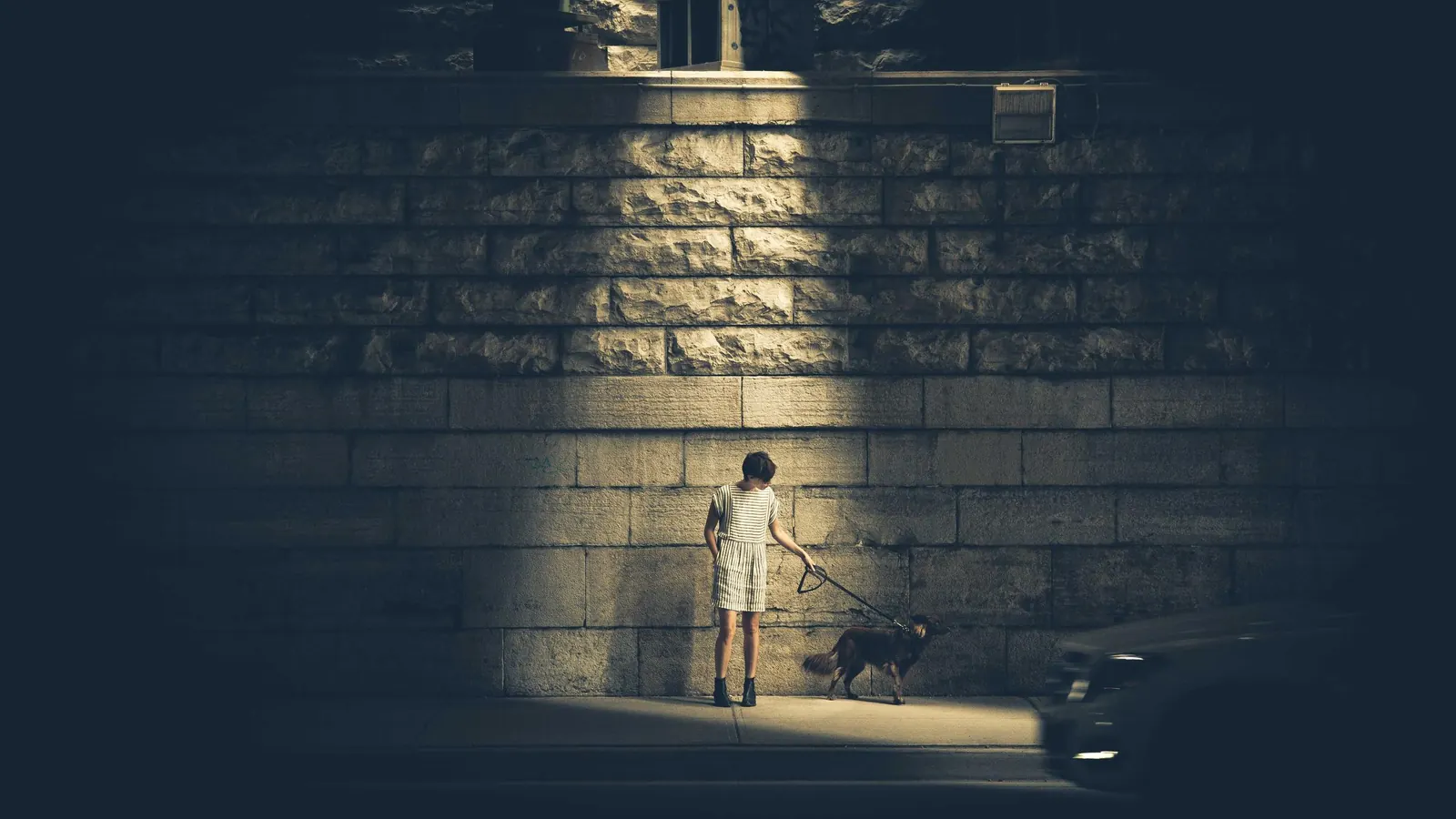
In street photography with a phone you rarely control the scene, so simplicity often comes from waiting: picking a clean background, such as a plain wall in good light, and letting a single person walk into it.
Can you simplify a photo after taking it?
Yes, to a degree. Cropping is the most honest simplifying tool, because it removes rather than adds. Trimming an edge can eliminate a distracting object, tighten the frame around the subject and change the balance completely. Many photos contain a cleaner, stronger image hidden inside them, a point explored in one photo, many crops.
Limits are real, though. Every crop throws away pixels, and you cannot crop out something that overlaps your subject. Lowering the saturation of a distracting color or darkening a bright corner can help, but heavy editing tends to look like editing. Simplifying at the moment of capture is always better.
If you want a second opinion on what to remove, an app like WisWit looks at your photo, suggests several tighter crops next to the original and explains briefly why each one works. It only crops, rotates and adjusts tone, never generating new pixels, so the simplified version is still your real photo, saved as a new copy.
When does simplicity go too far?
A frame can be so reduced that it loses its reason to exist. If you remove the context that made a scene meaningful, such as the crowd that made one quiet person interesting or the street sign that told you where you were, the image may become clean but empty. Ask whether each element you are about to remove is a distraction or part of the story. Keep the story; remove the noise.
Minimal images also depend on execution. With only one shape on a plain background, small flaws become obvious: a slightly crooked line, uneven exposure or a subject placed a little off where it should be. Simplicity raises the standard for precision.
A subtraction exercise for this week
Choose one ordinary object at home, such as a cup, a plant or a pair of shoes, and take five photos of it. In the first, shoot it where it is, with everything around it. In each following frame, remove one distraction by moving closer, changing height, shifting sideways or choosing a plainer background. By the fifth frame you should have a photo where nothing could be removed without losing the subject. Compare the first and last; that difference is the whole lesson.
Frequently asked questions
What makes a photo minimalist?
A minimalist photo uses very few elements, often a single subject, on a clean background with large areas of empty space and a limited color palette. The subject is usually a simple shape: a tree, a person, a boat, a window. Precise placement matters a lot because there is little else to look at, so minimalist photographers often rely on the rule of thirds and negative space.
How do I get a clean background with a phone?
Look for plain surfaces first: sky, water, a painted wall, sand or a tabletop. Then change your position so one of them sits directly behind your subject, usually by crouching, shooting from above or stepping sideways. Using the 2x or 3x lens and moving closer also reduces background clutter, and portrait mode can blur whatever is left.
Is a simple photo the same as a boring photo?
No. A boring photo lacks a clear subject or reason to look; a simple photo has a clear subject and nothing that distracts from it. Simplicity often makes an image more striking, because shape, light and color have room to work. What makes a simple photo interesting is a strong subject, good light or an unusual moment, not the number of elements.
Should I remove people from my travel photos to keep them simple?
Not necessarily. People often add scale, life and story to a place. The goal is to avoid random, half-cut figures at the edges that distract. Wait for a moment when one or two people sit in a clear spot, or frame them as a deliberate small figure against a big scene. Remove distractions, not context.